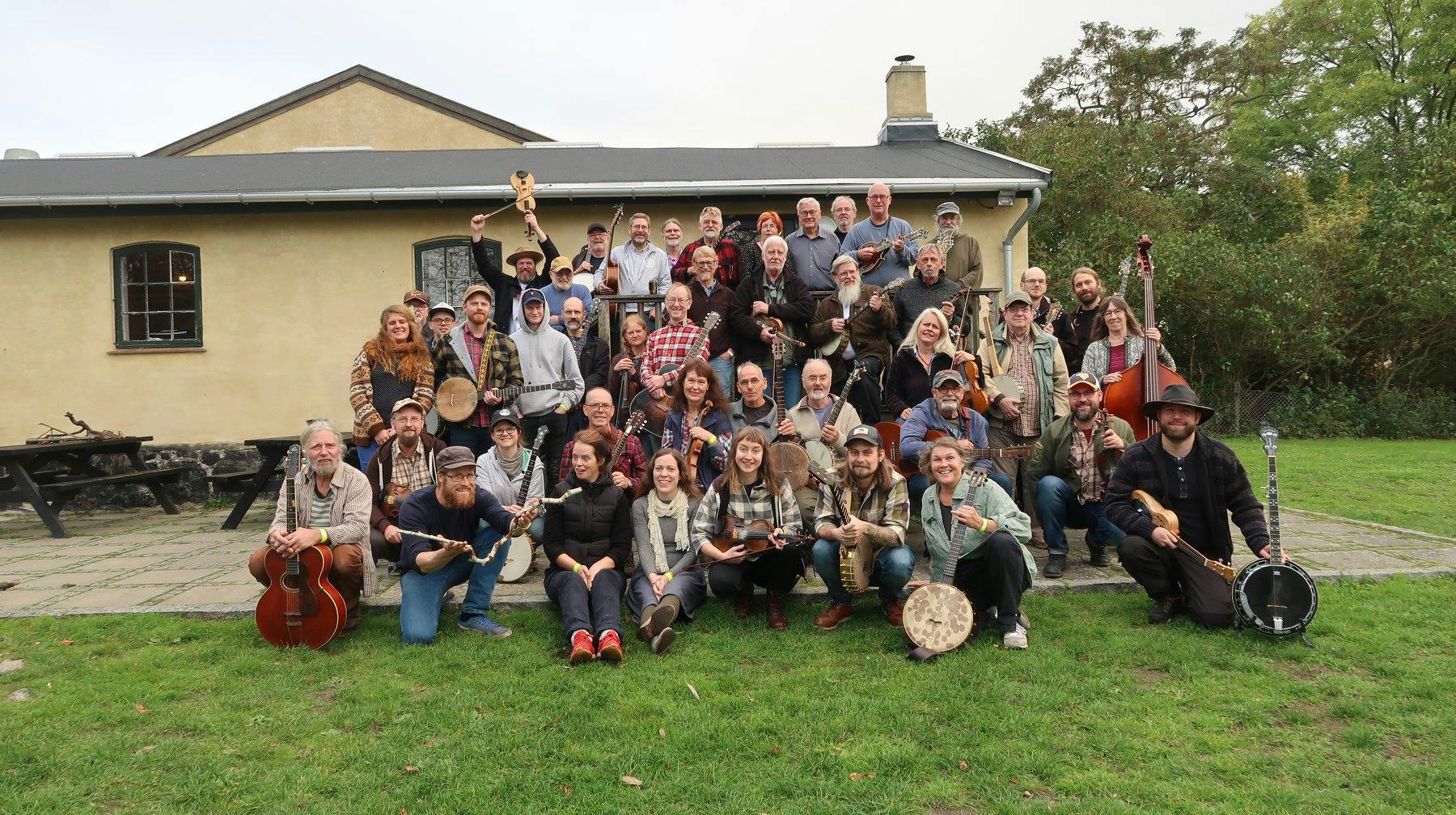
Så er datoen sat til næste oldtime jam på Mellemrummet.
D. 22/5, fra 19-23.
Månedens melodi er Getting Up the Stairs fra Clyde Davenport.
Der forekommer en del forskellige variationer af denne tune – og nogle er knap så kompatible med hinanden.
Her kan du høre Clyde Davenport spille Getting up the Stairs.
Play Pause
Stop
HIDE PLAYLIST
Melodien er i A og fiddlen stemmes AEae.
Clyde Davenport
I modsætning til de andre musikere hvis melodier har været månedens melodi, så er Clyde Davenport i live. Han er idag rundet 90 år og har spillet fiddle og banjo i mere end 70 år. Clyde er fra Kentucky og lærte i sin ungdom at spille musik. En af hans mentorer var Leonard Rutherford – halvdelen af den duoen Burnett and Rutherford der indspillede 78ere i 1920erne – men Clyde siger at hans talent for musik var “a gift” og at ingen har lært ham at spille.
Så er datoen sat til næste oldtime jam på Mellemrummet. D. 17/4, fra 19-23.
I anledning af flere opfordringer så vil vi vælge månedens melodi, så alle kan forberede sig på at spille noget konkret.
Valget er faldet på:
Rockingham Cindy
Cindy er en meget udbredt melodi der går i D. Men Rockingham Cindy er en version af melodien/sangen der kommer fra Surry County, North Carolina. Det er en crooked melodi. Dvs man skal lægge mærke til det lille hop i slutningen af den lave del.
Her er kildeversionen. En optagelse med Surry Countys mest kendt fiddler Tommy Jarrell.
Play Pause
Stop
HIDE PLAYLIST
Her spilles den af Eddie Bond og Kirk Sutphin
Fiddlen stemmes ADae og banjoen stemmes aDADE
Tommy synger:
Never loved old Cindy, don’t expect I ever shall.
Never loved old Cindy, but I love old Cindy’s gal.
Omkvæd: It’s come along home, Cindy, Cindy.
Knock along home Cindy, Cindy.
Where’d you get your whisky, where’d you get your dram?
Where’d you get your whisky at? Way down in Rockingham.
Where’d you get your whisky, where’d you get your dram?
Where’d you get your whisky at? (talt) well it don’t make a damn…
Rockingham ligger i det sydlige North Carolina, ca 200 km syd/vest for Tommy Jarrels hjem i Mt. Airy.
Om Cindy skrives:
AKA “Cindy in the Summertime,” “Cindy in the Meadows,” “Get Along Home (Miss) Cindy,” “Git Along, Cindy,” “J’etais au Bal,” “Old Time Cinda,” “Run Along Home, Cindy,” “Whoop ‘Em Up Cindy,” Old‑Time, Song and Breakdown. USA; Arkansas, North Carolina, Tennessee, Kentucky, Georgia, Mississippi. D Major (most versions): G Major (John Brown). Standard or ADae tuning.
A widely known frolic tune, appearing in many folk music collections and even old elementary school songbooks. The title appears in a list of traditional Ozark Mountain fiddle tunes compiled by musicologist/folklorist Vance Randolph, published in 1954, and was recorded for the Library of Congress in 1939 by Mississippi fiddler John Brown. A very popular Cajun version of the tune, probably borrowed from the American song, is “J’etais au Bal” (I Went to the Dance Last Night). Verses set to the tune are many, including several “floaters”
Om Tommy Jarrell:
Thomas “Tommy” Jefferson Jarrell was born March 1, 1901 in Surry County, N.C. to Benjamin “Ben” Franklin Jarrell and Susan “Susie”Letisha (Amburn) Jarrell. He was born in his parents’ home at the foot of Fisher Peak and was raised in the Round Peak area of Surry County, N.C. He had one foster sister (a first cousin) that was older than Tommy and ten younger brothers and sisters. The family raised corn, buckwheat, rye, beans, cabbage,sugar cane, sweet potatoes, Irish potatoes, and apples to feed this large family. They also raised tobacco and owned cattle.
Tommy would tell of how hard he had to work. He began plowing at the age of eight or nine and would work from sunup to sundown. He said his grandfather Rufus Jarrell never knew when to quit working, that he’d try his best to find something for you to do on a rainy day. The family had hired Bauga Cockerham to help on the farm and he was the one who taught Tommy his first tune on the banjo. Tommy was probably around seven years old when Bauga taught him to play Ol’ Reuben. About a year later, Tommy’s father bought him his first banjo. At age thirteen, he began to fiddle on his dad’s fiddle. His dad had bought the fiddle from Tony Lowe’s widow for five dollars. When Tommy was 14, in 1915, he bought his own fiddle for ten dollars from Huston Moore, having borrowed the money from Ed Ward. Tommy said he like to never got the fiddle paid for. Tommy still had this fiddle in the 1980s. Tommy’s fiddle is now part of the Smithsonian Institute collection in Washington, D.C.
Tommy grew up playing dances or “workings” all over Round Peak. Back then, neighbors had “workings” such as wood choppings, barn raisings, apple peelings, bean stringings and corn shuckings. There was always a dance at the end of these gatherings. Tommy could sing to most of the tunes he played, but he would admit that he was a better fiddler than a singer.
Tommy attended Ivy Green School and quit in the seventh grade. He took his first car ride around 1916 in a T-model Ford. He said his daddy drove him and a couple of his sisters to the fair in Mt. Airy. He said he would never forget how that thing looked coming up the road. He said if he hadn’t known what it was, it would have scared him to death. Tommy’s uncle, Charlie Jarrell, taught him how to make sugar whiskey back around 1918. He said they made a pretty good turnout. In 1920, Tommy made a six-month trip to South Dakota to make whiskey for an ex-North Carolinian there who was dissatisfied with the local supply.
On December 27, 1923 at the courthouse in Hillsville, Carroll County, VA, he married Nina Frances Lowe, daughter of Charles and Ardena Leftwich Lowe. Tommy had known Nina about two years before he married her. He proposed while they were hoeing corn one day. He said “Nina, we’ll get married if you want to. But I’ll tell you right now, I make whiskey, I play poker, and I go to dances, make music, and I don’t know whether I’ll ever quit that or not. But, if you think we can get along now, we’ll get married – and if you don’t think we can, right now’s the time to say something.”
“Well,” Nina said, “I believe we’d get along all right.” And that was the way it happened.
Tommy and Nina lived with her parents during 1924. Both of her parents had died by the end of that year, and Tommy and Nina moved to Mt. Airy, NC and lived for a year with his parents. Children born to Tommy and Nina were Ardena “Dena” born February 25-27 [long labor?!]1925, Clarence “Wayne” born February 8, 1927, and Benjamin Frankin “B.F.” born September 19, 1933. Tommy and his family later lived on the South Franklin road in the Toast community near Mt. Airy, N.C. He was an employee with the North Carolina Department of Transportation for 41 years, beginning work in April of 1925 and retiring in 1966.
By 1975, Tommy had recorded seven albums. He had traveled to many colleges and universities around the country to play. He had played at the Smithsonian Institute in Washington, D.C. And many festivals around the country have played host to Tommy and his music. In 1982, he was selected as one of the fifteen master folk artists in the first National Heritage Fellowships of the National Endowment for the Arts. He received a certificate and monetary award at a ceremony at the annual American Folklife Festival in Washington, D.C. A film titled “Sprout Wings and Fly” was made about Tommy and can be purchased on video.
The Round Peak area is well-known for its history of Old-Time Music and the Jarrell family contributed to that tradition. Tommy was the community’s most famous old-time musician. His legendary fiddle playing brought him worldwide recognition. His father Ben had also recorded numerous songs [with DaCosta Woltz's Southern Broadcasters] and was considered one of the best musicians in his generation. Tommy was always eager to share his music with anyone. He enjoyed people and could entertain his visitors for hours with his music and storytelling. His favorite stories were about relatives, neighbors and friends who grew up new Fisher’s Peak and in the Round Peak community.
After Tommy became popular, people came from everywhere in the United States and from overseas, especially Europe, to see him and get him to teach them his style of fiddling. People ended up staying such a good length of time that a friend of his named Steve made a sign for him to put over his door that read “First Two Nights Free and After That $20 Per Night”.
Nina died February 13, 1967 and Tommy died January 8, 1985 at age 83. Both are buried at Skyline Memory Gardens in Surry County.
Her er information om Sam Dyer, skrevet af Boyd Deering:
Sam Dyer was approaching eighty years in 1975 and had played Tennessee fiddle tunes all his life. He played old tunes like “Jim Shanks,” and Sam played them differently from dad and Harry Flippen and some of the other fiddle players in Macon County, Tennessee. Sam would complain about the Grand Ole Opry and it’s commercial leanings. He longed for the old days and was quick to express this sentiment.
Sam was a relatively short man, possibly of Scotch-Irish descent, who was most often seen somewhat red-faced, his gray hair combed over to one side, and sporting well worn Liberty overalls. Sam and other old-time musicians would gather at the local music shop around ten o’clock on Saturday mornings to fiddle, tell stories, and have fun.
Så er datoen sat til næste oldtime jam på Mellemrummet.
D. 21/2, fra 19-23.
I anledning af flere opfordringer så vil vi fra nu af vælge månedens melodi, så alle kan forberede sig på at spille noget konkret.
Valget er faldet på:
Natchee on the Hill
Kildeoptagelsen kan høres her. Det er en fieldrecording med West Virginia fiddler Emory Bailey.
Play Pause
Stop
HIDE PLAYLIST
Hvis I vil høre en nyere fortolkning så er der her en optagelse med The Iron Leg Boys, der har lært den fra Emory Bailey optagelsen.
Nathee on the Hill er i Adur og spilles i AEae stemning på fiddle.
Som nævnt i optagelsen var det en af gamle Solly Carpenters favoritter. Læg mærke til West Virginia udtalen af “Favorite”. Solly Carpenter er det mest legendariske navn i hele den meget berømte Carpenter familie – som også indeholder Ernie Carpenter og French Carpenter. Der var to Solly’er (eller Solomon eller Sol) i Carpenter slægten. Den ene “Devil Sol” gav navn til melodien Camp Chase, fordi han vandt sin frihed fra et borgerkrigsfængsel (Camp Chase) ved at at spille den melodi i en konkurrence. Den anden Sol Carpenter (evt. Old Sol, der nævnes af Emory Bailey) blev født under en fremskudt klippe i skoven, hvilket gav navn til en anden hyppig Carpenter tune; Shelvin Rock.
Tirsdag d. 24 januar afholdt foreningen den tredje oldtime jam i København. Igen var det en stor succes, og jammen vender tilbage næstsidste tirsdag i februar.
Foreningen DAFF II arrangerer aktiviteter omkring traditionel amerikansk folkemusik.
Der er både dans og musik.
Foreningen er ukommerciel og upolitisk.
Vi mødes en weekend en gang om året i september måned ved Kattinge Vig ved Roskilde. Stedet hedder Kattinge Værk og er omgivet af smuk natur.
Troublesome Creek String Band ved træffet 2007 – Foto: Jesper Deleuran
Introduction
DAFF, Danish American Folk Music Association, has activities relating to traditional American folk music.There is mostly old time music, sometimes French-Canadian and there is square dancing.
We have an annual get-together in September at Kattinge Vig near Roskilde and it is situated in beautiful surroundings.Musicians and dancers of all levels are welcome.